
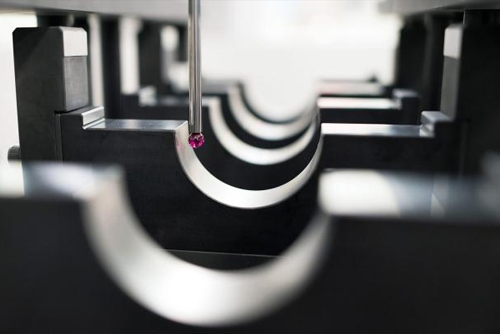
Core Characteristics of High-Precision Coordinate Measuring Machines (CMMs) for Standard Parts
Based on the document content, the specific characteristics can be summarized into four dimensions, which align with the core attributes of standard parts: precision benchmarking, specification universality, and batch consistency:
1. High Matching Between Precision and Benchmarking
As the "precision benchmark" in industry, standard parts require errors to be controlled at the micron or sub-micron level. High-precision coordinate measuring machines can achieve 3D measurement accuracy of 0.3 μm. Equipped with multi-sensor fusion technology and a reference sphere calibration mechanism, they can accurately capture key parameters such as the tooth profile and tooth pitch of gear standard parts, with errors converging within the ranges specified by industrial standards. They can meet the high-precision requirements of Grade 0-2 in GB/T 10095.1—2008, providing a reliable benchmark for downstream production.
2. Full-Category Adaptability and Flexible Inspection
They cover more than 95% of mainstream standard part categories, including gears, gauge blocks, and bearings, with size ranges from millimeter-level small parts to ton-level large gearbox standard parts. Through flexible switching between contact and non-contact scanning, as well as adaptation with special fixtures, they meet the needs of different materials such as hardened gear surfaces and ceramics. They can access complex structures such as the bottom of gear tooth grooves, realize non-destructive inspection of fragile parts, and eliminate the need for dedicated equipment.
3. Traceable Data and Standardized Output
They support real-time import of CAD models for data comparison, complete error correction and uncertainty evaluation according to the formula $$U = k\cdot\sqrt{u_{standard}^2 + u_{instrument}^2 + u_{environment}^2}$$ (where k=2, confidence level 95%), and generate standardized reports including measured values and deviation heatmaps. Meeting the requirements of the ISO 9001 system, they realize full-process traceability with "one report per part", which can serve as an authoritative basis for factory certification and in-service calibration.
4. Efficient Adaptation to Mass and Customized Requirements
Relying on intelligent software functions such as automatic path planning and multi-view data stitching, combined with rotary axis upgrade solutions, the measurement efficiency is improved by more than 50%, adapting to the mass production needs of standard parts. At the same time, they can accurately detect special parameters of customized standard parts, balancing the efficiency of mass quality inspection and the precision of customized parts, and meeting both accuracy and production capacity demands.



Scan WeChat
Enjoy one-to-one consultation


