
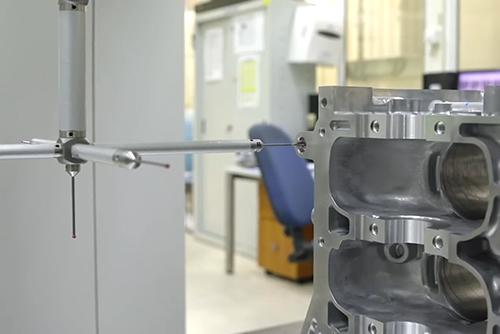
Optical video measuring machines are precision inspection instruments based on optical imaging, computer vision and intelligent image processing technologies. Adopting the non-contact measurement principle as their core mechanism, they capture workpiece images through high-resolution optical systems and extract key parameters including dimensions and geometric tolerances via software analysis. Accurate inspection can be completed without physical contact with the workpiece, making them widely applicable to the measurement of various parts in precision manufacturing, especially matching the characteristic requirements of electronic products. Combining micron-level accuracy, high inspection efficiency and non-destructive measurement, they serve as core equipment for quality control in industries such as 3C electronics and new energy lithium batteries.
I. Core Working Principle and System Composition
The machine mainly consists of three core parts: an optical imaging system, a motion control system, and intelligent analysis software. The optical system includes a high-sensitivity CCD camera, zoom objective lens and ring light source, which can switch between bright-field and dark-field illumination according to workpiece materials (e.g., transparent plastics, metal pins) to clearly display the contours of micro structures, with a resolution ranging from 0.3–2.6 μm/pixel. The motion control system drives the stage via high-precision guideways and positions with a grating ruler, guaranteeing the positioning accuracy and repeatability of the X and Y axes. The analysis software integrates automatic edge detection, contour fitting and data processing functions, enabling rapid image interpretation and result output. Some high-end models support linkage with a CAD module for model comparison and automatic path planning.
II. Core Advantages and Applicable Scenarios
Compared with contact measuring devices, optical video measuring machines offer three core advantages. First, non-destructive measurement: data is acquired through optical imaging without contact pressure, allowing accurate inspection of fragile and deformation-prone workpieces such as PCBs, thin-walled housings and ceramic components, and eliminating damage caused by clamping and probing. Second, high-efficiency full-coverage measurement: supporting single-point measurement, scanning measurement and one-shot flash measurement, batch inspection of electronic components can instantly cover up to 100 parts with 300 dimensions per part, boosting efficiency by several times over traditional methods. They can also capture complex structures inaccessible to contact devices, such as tooth grooves and circuit gaps. Third, user-friendly operation: no professional debugging is required. Equipped with automatic edge detection and focus locking functions, they eliminate human judgment errors and satisfy both high-precision laboratory inspection and rapid on-line spot inspection demands.
III. Key Practical Points for Electronic Product Measurement
In view of the tiny dimensions, complex structures and mass-production nature of electronic products, standardized procedures are required to ensure measurement accuracy:
1. Pre-Measurement: Environmental and Equipment Calibration Maintain a constant laboratory temperature of 20 ± 0.5 °C to control thermal expansion error within ≤ 0.5 μm/m. Install the equipment on an air-floating vibration isolation table to dampen vibration (guideway vibration amplitude ≤ 1 μm/s). Calibrate the linear accuracy of the X and Y axes with a 50 mm ceramic gauge block (accuracy ± 0.5 μm) after each startup. When a ruby stylus is fitted, calibrate it with a reference sphere to ensure stylus diameter error < 0.0005 mm. Use vacuum adsorption or multi-point flexible positioning for clamping to prevent deformation of PCBs and thin-walled parts.
2. During Measurement: Scenario-Based Adaptation Strategies For PCB circuit measurement, use a high-magnification optical system together with a line width and spacing tester to precisely control line width and spacing deviations and avoid risks of etching defects. For micro-components (pins of resistors and capacitors), activate automatic edge detection; extend measuring lines by 1–2 mm beyond endpoints for straight features, and collect ≥ 6 points for circular features, with deviations calculated via least-squares fitting. Adopt one-shot flash measuring machines for batch products to realize quick, non-positioning measurement and greatly improve inspection efficiency.
3. Error Control and Data Processing Unified focus using the "peak sharpness method" to lock the Z-axis. For high-precision components, take the average of three repeated measurements at the same position (standard deviation σ < 0.001 mm). The software automatically extracts contour dimensions, generates deviation heatmaps and standardized reports, and supports data export for SPC statistical analysis. For measuring moving parts, activate a high-speed camera (frame rate ≥ 100 fps) and high-frequency stroboscopic light to collect coordinates frame by frame and avoid motion blur.



Scan WeChat
Enjoy one-to-one consultation


