
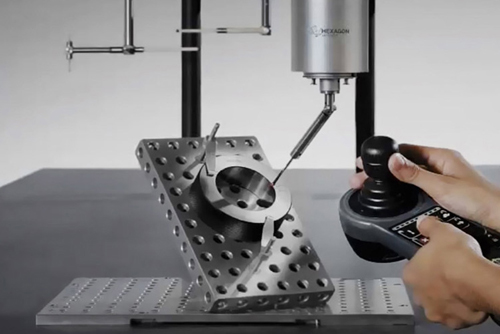
Electronic products, including PCBs, micro-components, thin-walled housings and similar parts, feature tiny dimensions, complex structures, fragile materials and mass-production characteristics. With the advantages of non-contact measurement, high-precision optical systems and intelligent image processing capabilities, video measuring machines (VMMs) have become the core equipment for dimensional inspection and quality control of such products. Through the coordinated control of hardware calibration, software optimization and standardized procedures, micron-level precision measurement can be achieved, meeting the stringent inspection requirements in 3C electronics, new energy lithium batteries and other industries.
Pre-Measurement Preparation: Hardware Calibration and Environmental Control Lay the Foundation for Accuracy. For environmental control, a constant temperature of 20 ± 0.5 °C must be maintained in the laboratory to avoid thermal expansion errors caused by temperature fluctuations (controlled within 0.5 μm/m). Meanwhile, the equipment should be installed on an air-floating vibration isolation table, away from vibration sources such as punches and fans. The guideway vibration amplitude shall be inspected with a laser interferometer to ensure it is ≤ 1 μm/s, eliminating external interference. Equipment calibration must follow strict standardized procedures. After each startup, a 50 mm ceramic standard gauge block with an accuracy of ±0.5 μm is used to verify the linear accuracy of the X and Y axes; recalibration shall be performed immediately if the error exceeds 0.002 mm. When using a ruby stylus (diameter 0.5–2 mm) for 3D parameter measurement, the stylus must be calibrated with a reference sphere to ensure the diameter error is less than 0.0005 mm, and the probing speed shall be controlled within 0.1 mm/s to prevent damage to sensors and fragile electronic components. Special flexible fixtures are adopted for clamping. For deformation-prone parts such as PCBs and thin-walled housings, vacuum adsorption or multi-point lightweight positioning is applied to avoid deformation errors caused by clamping forces.
In-Measurement Execution: Scenario-Based Adaptation and Software Empowerment for Accurate Acquisition. According to the characteristics of different electronic products, measurement modes and acquisition strategies should be flexibly adapted. For fine circuits on PCBs, a high-sensitivity color CCD camera and optical magnification system are used, together with a hand-held line width and spacing tester (e.g., Bamtone D300 series), achieving a resolution of 0.3–2.6 μm/pixel and repeatability of ±1 pixel. This enables precise measurement of line width and spacing, prevents open and short circuits caused by over-etching or under-etching, and monitors process capability for timely adjustment of process parameters. For micro-components (e.g., pins of resistors and capacitors), the automatic edge-finding function of the software is activated. When measuring straight lines, data points are collected with an extension of 1–2 mm beyond the endpoints to avoid the influence of chamfers; when measuring arcs, more than 6 points are uniformly distributed for acquisition, and dimensional deviations are calculated by least-squares fitting. For mass-produced electronic components, one-touch video measuring machines (instant measuring systems) are adopted. Measurement can be completed with a single press after random placement, covering up to 100 parts and 300 dimensions per part in an instant. No professional operation is required, eliminating human errors and greatly improving inspection efficiency.
Error Control and Data Processing: Full-Process Traceability Ensures Reliable Results. To avoid operational errors, a unified "peak sharpness method" is adopted for focusing by multiple operators: the Z-axis is locked when the software displays the maximum contrast, preventing height deviations caused by subjective judgment. For high-precision electronic components, the same position is measured three times repeatedly, and the average value is taken; a standard deviation σ < 0.001 mm is regarded as stable measurement. Data processing relies on intelligent image processing software, which supports automatic contour recognition, key dimension extraction, deviation heatmap generation and standardized reporting. Data can be exported for SPC statistical analysis, providing support for process optimization and quality traceability. For special scenarios such as moving parts, a high-speed camera (frame rate ≥ 100 fps) and high-frequency stroboscopic light are activated. Key point coordinates are collected frame by frame through video recording, generating displacement-time curves to accurately analyze motion trajectory accuracy and avoid measurement interference caused by motion blur.
In addition, equipment types should be flexibly selected according to the category of electronic products. Benchtop video measuring machines can be used for high-precision laboratory inspection, integrated with a CAD module to realize model comparison and automatic path planning. For spot inspection on the production line, hand-held devices are preferred, allowing immediate measurement after startup and on-site quick judgment of out-of-tolerance conditions without workpiece handling. This adapts to fragmented and high-frequency inspection demands, balancing accuracy and efficiency.



Scan WeChat
Enjoy one-to-one consultation


