
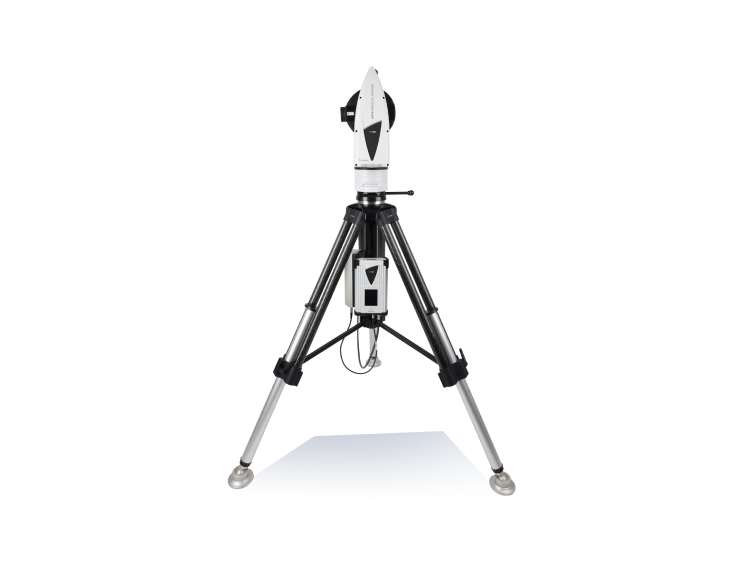

From large cargo ships to luxury cruise liners, from ocean-going research vessels to advanced naval craft, China’s shipbuilding industry is advancing at an unprecedented pace toward high-quality, intelligent development. In this process, shipbuilding has long faced unique measurement challenges. Large vessels are built using a block construction method, where hull blocks, decks, bulkheads, and other components are enormous in size, making it difficult to achieve comprehensive full-scale precision coverage. At the same time, the structural complexity of components and the tightly interlocked assembly sequences—ranging from block welding to final berth assembly, from propulsion system calibration to pipeline layout optimisation—mean that every single step relies on high-accuracy data support.
However, traditional measurement methods commonly suffer from bottlenecks such as low efficiency, limited accuracy, and cumbersome operations. These often lead to assembly deviations and persistently high rework rates, severely impacting production cycles and manufacturing costs. With its outstanding technical performance, the Hexagon Leica laser tracker provides the industry with comprehensive precision measurement solutions and is emerging as a key force driving the transformation and upgrading of smart shipbuilding.
Hull Construction and Assembly
The ATS800 Enables Precision Control Throughout the Entire Process

During the hull construction and assembly phase, the Leica ATS800 laser tracker, backed by metrology-grade accuracy and an IP54 protection rating, provides an ideal on-site measurement solution for large-scale structural surveys. Compared with traditional methods, the ATS800 enables efficient 3D scanning without the need for targets. Its large-volume, non-contact measurement capability is particularly well suited for rapid surface scanning and precise boundary measurement of large shipbuilding workpieces.
The Leica ATS800 supports direct selection of designated areas from CAD models for feature scanning. Its proprietary Feature Detection and TruePoint technologies enable automatic and precise capture of workpiece details, making it particularly suitable for block control point inspection and virtual assembly tasks. This significantly reduces the need for working at height, greatly enhancing on-site measurement safety, efficiency, and data traceability.
In practical applications, the ATS800 can quickly determine the position of large components during final assembly positioning, and achieve precise scribing and accurate control of cutting allowances at block joint surfaces. Combined with an AGV system, it can also enable automated mobile measurement, obtaining complete 3D data through multi-station data registration, thereby comprehensively improving the assembly accuracy and efficiency of ship construction.

Propulsion System Installation
High-precision equipment solves key process challenges.
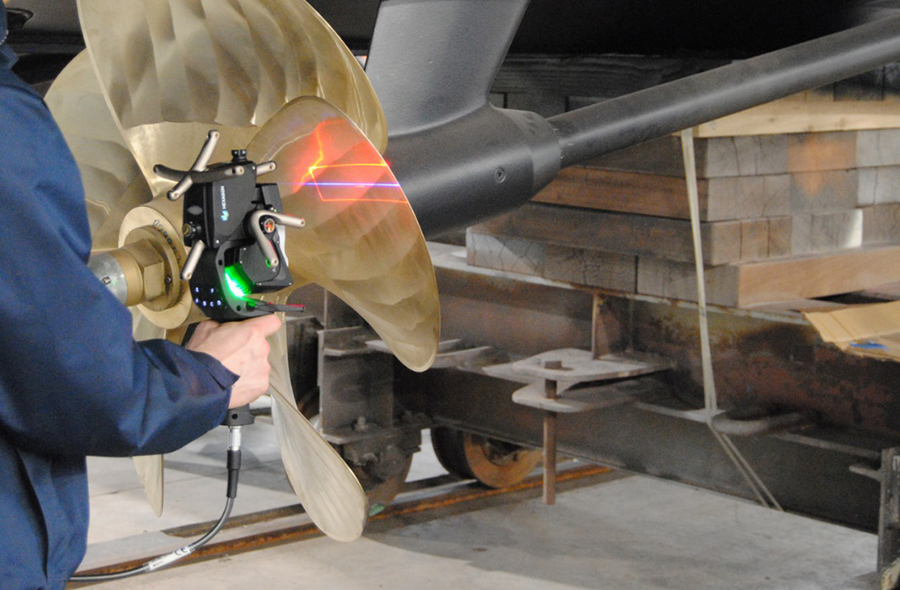
Propulsion system installation is one of the most critical and demanding processes in shipbuilding, requiring the highest levels of precision. The Leica AT960 laser tracker, with its outstanding adaptability, enables fast and accurate measurement of key points using the T-Probe handheld touch probe, or can be combined with the AS1 series blue-light scanning probe to capture high-density 3D data. This allows efficient, flexible, and obstruction-free precision measurement even in the cramped and complex environment of the engine room.
In the critical process of ship shaft alignment, the measurement system enables dynamic data acquisition and real-time analysis at key points along the shafting, directly guiding on-site adjustment operations. It achieves precise calibration of shaft straightness and concentricity, ensuring that the propeller shaft, intermediate shafts, and engine reach an ideal alignment state, thereby guaranteeing efficient and smooth power transmission. In addition, the system is equally suited for high-precision measurement tasks such as engine foundation flatness inspection and mounting hole pattern positioning. Its measurement efficiency and result reliability significantly outperform traditional methods like total stations.
Piping System Commissioning
3D digital solutions ensure efficient installation.

During the piping system commissioning phase of shipbuilding, the Leica laser tracker demonstrates outstanding technical value. By employing the Leica AT960 tracker paired with the AS1 blue-light scanning probe, technicians can efficiently acquire complete 3D point cloud data of the piping system and its surrounding environment. This combination fully leverages the AT960's high-precision measurement capability in complex spaces and the AS1's advantage in high-efficiency data acquisition.
Based on the precise 3D data obtained, engineers can carry out virtual assembly and interference analysis of the piping system on professional software platforms, optimising pipe routing in advance and effectively avoiding potential conflicts during installation. The system also provides accurate data support for the prefabrication of pipe fittings, and guides precise positioning during on-site installation, ensuring proper alignment of all connection interfaces. This significantly reduces installation rework, and comprehensively improves construction quality and operational efficiency.
With its comprehensive technical advantages and wide range of application scenarios, the Leica laser tracker has become the preferred measurement equipment for numerous shipbuilding enterprises. It not only helps companies substantially reduce rework costs and shorten production cycles, but also drives the transformation of the shipbuilding industry toward high precision, high efficiency, and intelligent manufacturing.
Looking to the future, Hexagon will remain customer-needs oriented and driven by technological innovation, continuously iterating Leica laser tracker technology. We are committed to helping China’s shipbuilding industry break through technical bottlenecks, venture into the deep sea and open oceans, and create even more brilliance in the global marine equipment manufacturing sector.



Scan WeChat
Enjoy one-to-one consultation


